

In this article, we'll break down two key stages: first, we'll create a repository for email templating, and then we'll configure local test sending via SMTP.

Dmitry Berdnikov
Frontend Developer
Why go through all this?
On one of our projects, we actively use HTML emails. Initially, templates were placed directly in the backend microservices - scattered and with repetitive parts. This created difficulties in maintenance and email testing. We wanted to simplify the development process, and most importantly - make email templating and checking convenient.
And as we know, email templating is painful. It's like you're developing for Internet Explorer - if you even remember what that is.
We decided to create a separate repository where all email templates would be stored. The backend would be able to pull them centrally.
The next step was choosing tools for templating and testing. We considered:
We wanted to write in a higher-level language, using pre-built components. With Maizzle and Foundation HTML, it seemed like we'd have to write more raw HTML code.
In the end, we settled on MJML - a markup language for email templates that compiles into full-fledged HTML, adapted for the specifics of email clients.
MJML is a language designed for HTML email templating, which compiles into regular HTML. This means you can write in an abstract syntax that then turns into HTML code with support for different mail clients. This eases adaptation for various mail clients and gives the ability to use:
You can see how MJML code turns into HTML here.
Let's go through the basic project setup - without delving into MJML syntax.
Install dependencies:
npm install mjml live-server concurrently
What each one does:
Add to scripts:
"scripts": {
"start": "mjml --watch ./src/templates/**/*.mjml --output ./templates",
"server": "live-server --host=localhost --watch=templates --open=templates --ignorePattern=\".*.mjml\"",
"dev": "concurrently \"npm run start\" \"npm run server\"",
"build": "mjml ./src/templates/**/*.mjml --output ./templates"
}
What each command does:
start - watches *.mjml files in src/templates/, compiles them to ./templatesserver - starts a server and tracks changes in ./templatesdev - runs start and server in parallelbuild - one-time template compilation without a watcherCreate a file example.mjml at /src/templates/example.mjml. All templates will be in the /src/templates folder. Add the following code to the file:
<mjml>
  <mj-body background-color="#f5f5f5">
    <mj-section padding="40px 0 20px">
      <mj-column>
        <mj-text align="center" font-size="28px" font-weight="bold">Email built with MJML</mj-text>
      </mj-column>
    </mj-section>
    <mj-section background-color="#ffffff">
      <mj-column>
        <mj-image src="https://placehold.jp/300x200.png" />
      </mj-column>
      <mj-column>
        <mj-text font-size="18px" font-weight="bold">Hello, world!</mj-text>
        <mj-text>This email was sent using MJML.</mj-text>
      </mj-column>
    </mj-section>
    <mj-section>
      <mj-column>
        <mj-button href="#" background-color="#4CAF50">Subscribe</mj-button>
      </mj-column>
    </mj-section>
  </mj-body>
</mjml>
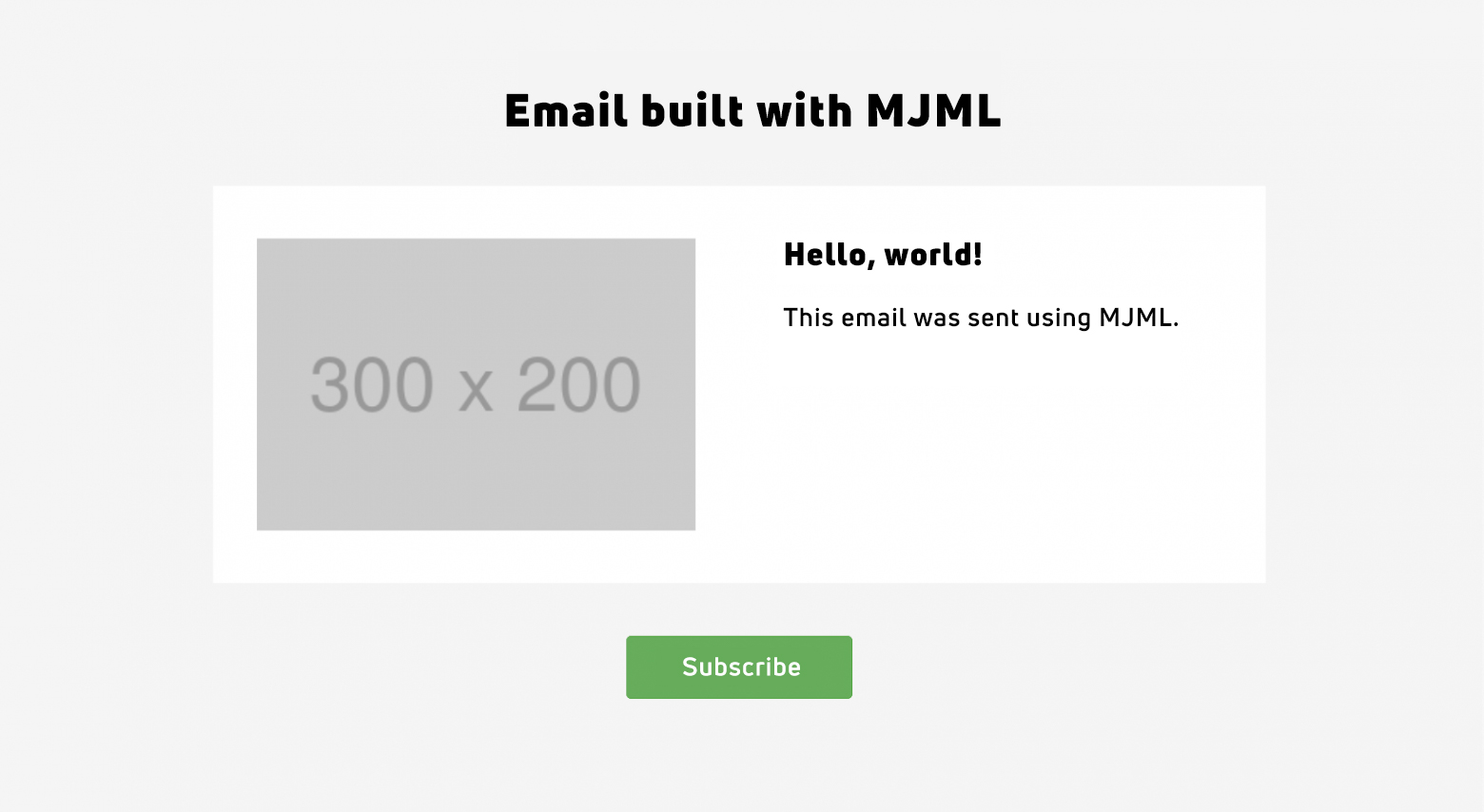
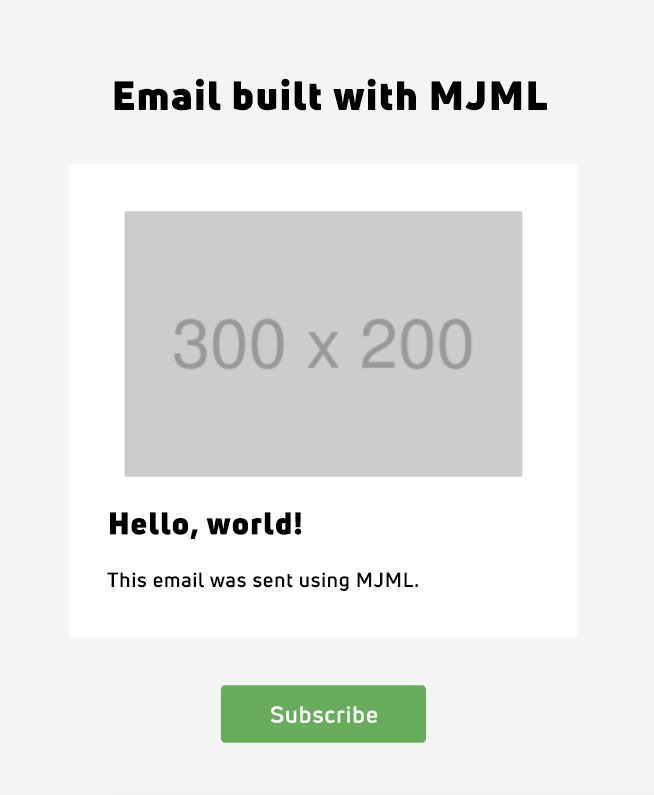
Run npm run dev - and a browser will open with the HTML generated from MJML. Each time the template changes, the page will automatically update. It's also useful to create a ./src/parts folder for reusable layout components.
As a result, we'll get desktop and mobile versions.
In the ./src/parts folder, create reusable email parts:
./src/parts/global-settings.mjml
<mj-style inline="inline">
  body { background-color: #f0f4f6; font-family: Arial, sans-serif; }
  a { color: #1d5cdb; text-decoration: none; }
</mj-style>
<mj-attributes>
  <mj-text
    font-size="17px"
    line-height="24px"
    color="#000"
    padding-top="5px"
    padding-bottom="5px"
  />
</mj-attributes>
./src/parts/header.mjml
<mj-section>
  <mj-column>
    <mj-image
      src="https://placehold.jp/82x47.png"
      alt="Logo"
      width="82px"
      height="47px"
    />
  </mj-column>
</mj-section>
Let's include them in example.mjml and remove unnecessary styles:
<mjml>
  <mj-head>
    <mj-include path="../parts/global-settings.mjml" />
    <mj-title>Example</mj-title>
  </mj-head>
  <mj-body>
    <mj-include path="../parts/header.mjml" />
    <mj-section padding="40px 0 20px">
      <mj-column>
        <mj-text align="center" font-size="28px" font-weight="bold">Email built with MJML</mj-text>
      </mj-column>
    </mj-section>
    <mj-section background-color="#ffffff">
      <mj-column>
        <mj-image src="https://placehold.jp/300x200.png" />
      </mj-column>
      <mj-column>
        <mj-text font-size="18px" font-weight="bold">Hello, world!</mj-text>
        <mj-text>This email was sent using MJML.</mj-text>
      </mj-column>
    </mj-section>
    <mj-section>
      <mj-column>
        <mj-button href="#" background-color="#4CAF50">Subscribe</mj-button>
      </mj-column>
    </mj-section>
  </mj-body>
</mjml>
We get the result:
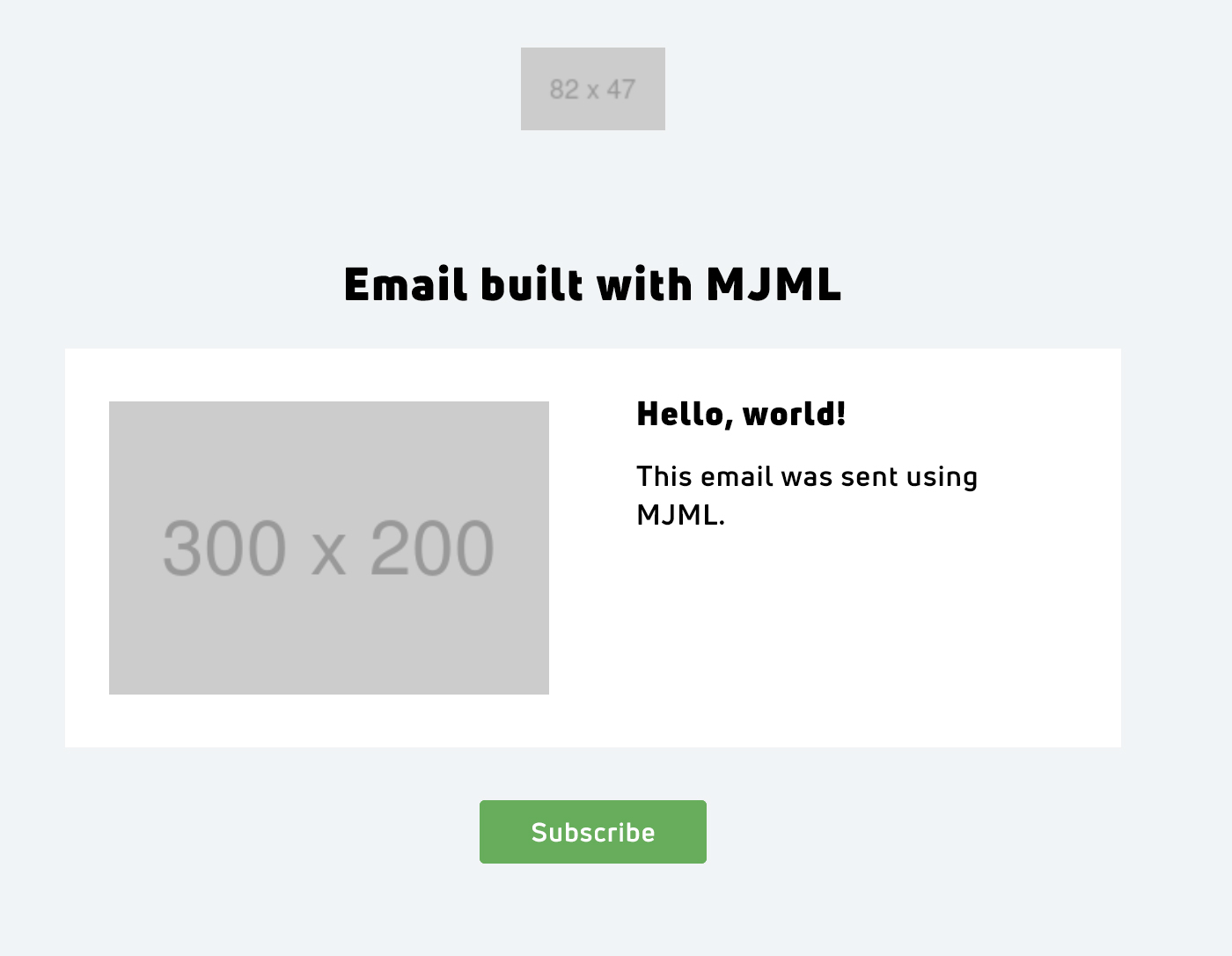
In summary:
Our project backend is written in Go. The compiled email templates end up in the ./templates folder. From there, the backend can pull them and send emails. In our case, connecting templates looks like this:
1. In the project root - go.mod:
module gitlab.site.ru/front-html-email-templates

go 1.22.0
2. In ./templates/templates.go
package templates

import _ "embed"

//go:embed example.html

var Example string
When adding a new template, a similar variable needs to be added to templates.go.
Also, emails have variables that the backend substitutes using its templating engine. In our case, the syntax for variables is {{.variableName}}.
<mjml>
  <mj-body>
    <mj-section padding="40px 0 20px">
      <mj-column>
        <mj-text align="center" font-size="28px" font-weight="bold">{{.title}}</mj-text>
      </mj-column>
    </mj-section>
  </mj-body>
</mjml>
To understand what variables are needed in a template, we created a ./docs/templates folder where we store markdown files with the same name as the template and a description of which variables are used, for example:
## Candidate

Email template 'Application without a vacancy'

### Variables
- `{{.date}}` Application Date
- `{{.title}}` Vacancy Title
- `{{.region}}` Region
- `{{.name}}` Full Name
- `{{.phone}}` Phone
- `{{.email}}` Email
- `{{.comment}}` Comment
- `{{.resume_link}}` Resume Link
- `{{.year}}` Current Year
The variables themselves can be added to the files by the backend developer, and the frontend developer just needs to place them in the layout in the correct spots.
Let's write a simple JS script that will send our templates to a real email.
First, install the following packages:
npm install dotenv nodemailer
dotenv — package for loading .env files in JS;nodemailer — package for sending emails with SMTP support.After that, create a file ./send-test-email.js and add the code:
import nodemailer from 'nodemailer'
import dotenv from 'dotenv'
import fs from 'fs/promises'

dotenv.config()

async function sendTestEmail() {
  const transporter = nodemailer.createTransport({
    host: process.env.SMTP_HOST,
    port: process.env.SMTP_PORT,
    secure: true, // true for port 587, false for other ports
    auth: {
      user: process.env.SEND_FROM_EMAIL,
      pass: process.env.SEND_FROM_EMAIL_PASSWORD,
    },
  })gmail.com

  const htmlEmailString = await fs.readFile(
    `./templates/${process.env.TEMPLATE_NAME}.html`,
    'utf-8'
  )

  const mailOptions = {
    from: `Test Sender <${process.env.SEND_FROM_EMAIL}>`,
    to: process.env.SEND_TO_EMAIL,
    subject: 'Test HTML Email',
    html: htmlEmailString,
  }

  const info = await transporter.sendMail(mailOptions)
  console.log('Message sent: %s', info.messageId)
}

sendTestEmail().catch(console.error)
This is a simple implementation for sending emails via SMTP. We also need to create a .env file with the necessary variables:
TEMPLATE_NAME=email-confirmation
SEND_TO_EMAIL=test@byteminds.co.uk
SMTP_HOST=smtp.gmail.com
SMTP_PORT=587
SEND_FROM_EMAIL=test@gmail.com
SEND_FROM_EMAIL_PASSWORD=BcsftTdfdsf
TEMPLATE_NAME - the name of the template to be sent;SEND_TO_EMAIL - where the email will be sent;SMTP_HOST - SMTP host;SMTP_PORT - port;SEND_FROM_EMAIL - the sender's email address.SEND_FROM_EMAIL_PASSWORD - the sender's email password.Primarily, the TEMPLATE_NAME and SEND_TO_EMAIL variables change. For testing different templates and different mail clients.
The other variables only need to be configured once.
After all the setup, to send an email, you need to run the script:
node ./send-test-email.jsFor convenience, you can add a script to package.json. You can also implement support for bulk sending a template to different mail clients.
The current concept can be applied with other tools as well. As a result, we have:
It's important to keep in mind that templating can still break in old Outlook clients and with solutions like MJML where standard templates are provided. Even using best practices doesn't completely solve this issue. To avoid "breaking" in old solutions, you can use very trivial layout: simple texts and headings, no styling or visual elements.

It's easy to start working with us. Just fill the brief or call us.


Tatiana Golovacheva
My name is Tatiana, and I'm the Client Services Director at ByteMinds. Today, I'd like to share my thoughts and insights on communication, shaped by years of experience.

Anna Bastron
It lurks in every project older than a year: the code that defies logic. The instinct is to judge. But what if that instinct is holding your team back? At Umbraco Codegarden, I presented a simple yet powerful reframe: instead of asking "Who did this?", ask "What did they know back then?" The insight you gain might just save your next project.

Vladislav Bodin
The tech industry is shifting drastically, fueling both opportunity and anxiety, but the real first step is to conquer fear and embrace change not just learn new skills. Clear thinking comes before any career move.

Yakov Shevcov
In this article, I want to share not just impressions, but real experience of "surviving" in a commercial project. This is an honest story of what to be prepared for if you're looking for your first job.

Liya Vasilkova
In this article, I'll show you how to leverage the full power of AI assistants in the design implementation process, using the duo of Cursor IDE and an MCP Server as an example.

Vasil Khamidullin
This article will help you understand gRPC basics, how it differs from REST, the structure of .proto files, and most importantly- how to test gRPC services using Postman.

Bair Ochirov
In this article, I will briefly answer questions about why the CORS policy was created, how it works, why a simple action like "setting a header on the backend" might not be enough, and what secure patterns to choose for the frontend.
Dmitry Simonov
So, it's been a year since the last article, and a lot has changed. In this one, we're going to talk about integrating with Mock Service Worker (MSW).

Dmitry Bastron
Performance is not a feature to add later, but a core requirement as vital as security. This guide provides a structured approach to building performance into your web services from the start, ensuring they are fast and scalable by design.

Andrey Stepanov
This quick guide helps you define clear objectives and track progress effectively—ensuring every milestone counts.
Andrey Stepanov
A digital product isn’t just about features or design—it’s about teamwork. In this article, we break down the essential roles in digital product development.
Andrey Stepanov
Essential tips for creating a development team that works toward product goals, not just tasks.
Dmitry Bastron
Hi, my name is Dmitry Bastron, and I am the Head of Development at ByteMinds. Today, I’d like to share how I achieved Kentico MVP status, why I chose this CMS, and what it takes to follow the same path and earn the coveted MVP badge.
Maria Serebrovskaya
Hello! My name is Maria, and I am a team lead and backend developer at ByteMinds. In this article, I will share my experience: I’ll explain how to understand a complex project, establish processes, and make it feel like "your own".
Dmitry Simonov
In this article, we’ll take a look at how you can start testing Vue components.
Dmitry Bastron
This article is a cheat sheet to inspect what's going on with the imported data by Xperience by Kentico Migration Toolkit, resolve some CI/CD issues, and on many other occasions!
Anna Bastron
Let's try to understand how the ADM module works, its limitations, and tactics for optimising its performance.
Dmitry Bastron
The more mature Xperience by Kentico products become, the more often I hear "How can we migrate there?”
Andrey Stepanov
In this article, we will touch on where to start designing the architecture and how to make sure that you don’t have to redo it during the process.

Anton Vorotyncev
Today, we will talk about assessing algorithm complexity and clearly demonstrate how this complexity affects the performance of the code.
Tatiana Golovacheva
The development market today feels like a race - each lap is quicker, and one wrong move can cost you. In this race, excellent client service can either add extra points or lead to a loss due to high competition.
Dmitry Bastron
Ensuring security during development is crucial, especially as online and e-commerce services become more complex. To mitigate risks, we train developers in web security basics and regularly perform third-party penetration testing before launch.
Anna Bastron
In my previous article, I shared a comprehensive troubleshooting guide for Sitecore XM Cloud tracking and personalisation. This article visualises what happens behind the scenes when you enable personalisation and tracking in your Sitecore XM Cloud applications.

Sergei Pestov
All the text and examples in this article refer to Next.js 13.4 and newer versions, in which React Server Components have gained stable status and become the recommended approach for developing applications using Next.js.
Anton Vorotyncev
Imagine you have a solution to a problem or a task, and now you need to evaluate the optimality of this solution from a performance perspective.

Artyom Chernenko
Let's talk about how to organize the interaction of microservices in a large, long-lived product, both synchronously and asynchronously.
Dmitry Berdnikov
We suggest using a special editor to immediately check each example while reading the article. This editor is convenient because you can switch the TypeScript version in it.
Anna Gevel
One of the first things I tested in Sitecore XM Cloud was embedded tracking and personalisation capabilities. It has been really interesting to see what is available out-of-the-box, how much flexibility XM Cloud offers to marketing teams, and what is required from developers to set it up.
Dmitry Bastron
We will take you on a journey through a real-life scenario of implementing advanced tracking and analytics using Kentico Xperience 13 DXP.

Anastasia Medvedeva
Kentico stands as one of our principal development tools. We believe it would be fitting to address why we opt to work with Kentico and why we allocate substantial time to cultivating our experts in this DXP.
Anna Gevel
As a software development company, we at Byteminds truly believe that learning and sharing knowledge is one of the best ways of growing technical expertise.
Anastasia Medvedeva
Our expertise spans full-scale builds and support to upgrades and replatforming.
Sergei Pestov
How to stop the decline of the performance indicators of your e-commerce website and perform optimise page load performance.
Dmitry Bastron
We would like to share our experience of integrating Sitecore 9.3 with Azure AD B2C (Azure Active Directory Business to Consumer) user management system.
We'll consider the top-to-bottom approach for modeling content relationships, as it is more user-friendly for content editors working in the Kontent.ai admin interface.
Andrey Stepanov
All you need to know about Headless CMS. We also share knowledge about the benefits of Headless CMS, its pros and cons.
Fedor Kiselev
Let's talk about what enterprise development is, what nuances enterprise projects may have, and which skills you need to acquire to successfully work within the .NET stack.
Andrey Stepanov
We will explain how these agreements differ from one another and what projects they are suitable for.
Anna Gevel
We've collected various findings around decision models and programmable nodes working with Sitecore Personalize.
Anastasia Medvedeva
Our team boasts several developers experienced in working with Umbraco, specialising in development, upgrading, and replatforming from other CMSs to Umbraco.
Anastasia Medvedeva
Since 2015, we've been harnessing Kentico's capabilities well beyond its core CMS functions.
Egor Yaroslavcev
Chrome DevTools serves as a developer console, offering an array of in-browser tools for constructing and debugging websites and applications.
Dmitry Bastron
We'll dive into practical implementation in your Xperience by Kentico project. We'll guide you through setting up a custom activity type and show you how to log visitor activities effectively.